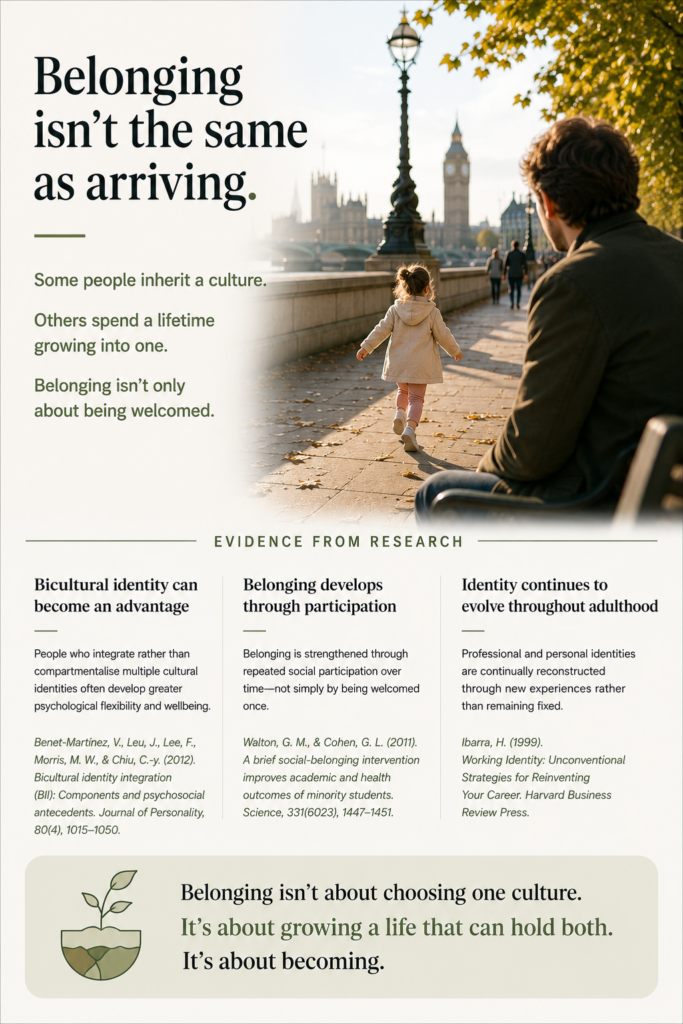
Eight years in the UK with a family and a career. And some days I still feel like a guest.
Not because someone makes me feel that way. Britons are genuinely kind. I think belonging isn’t just built by being welcomed, it’s built over decades, in school corridors and university friendships and over shared references that nobody has to explain because everyone just absorbed them growing up. That identity develops from childhood. You can arrive later, but you cannot retrieve the years.
Watching my three-year-old daughter grow up here makes this concrete in a way nothing else does. She is absorbing British culture the way children absorb language without effort, without translation, from the inside. She will never have to work out the unspoken rules because they will simply be hers. There is a German word for what I am watching: “Hineinwachsen”, growing into something from within, the way a tree grows into the shape of the space around it. She is doing that. While I am still finding my space.
It’s like a box in a box. Her British childhood is also simply a different childhood. It’s a different generation, different values, a different set of references. And all of that in a different culture to mine.
The strange part is that I am not fully German anymore either. Eight years changed my way of understanding, of solving problems and of the way I talk. Recently I was teaching on a paediatric emergency course in Germany. It’s a course I have run for years and a co-facilitator took me aside: “Arndt, you seem hesitant, people are not sure you are leading.” I had not lost my competence. I had lost my “Sachlichkeit.” Eight years of asking permission in British culture, and my old culture no longer recognised me, not because I had become worse, but because I had become different.
So I am not at home in the old culture, and I cannot fully enter the new one. And yet I am home, here and now. I am neither German nor British but a third thing entirely, a bicultural identity that didn’t exist before I built it, that has no flag, no passport, no childhood, and no one else who shares exactly this version of it.
I used to think of this as a problem of roots. But lately I wonder if the better question is about branches not where you are anchored, but what you are able to reach because you grow in different directions at once.
Psychologists call this bicultural identity. Research shows that people who integrate both cultures rather than suppressing one do better with lower stress, greater psychological flexibility, and a stronger sense of self. The science is reassuring. My lived experience feels much more complicated.
I am a German doctor practising British medicine, a partner and father in a country where I have no childhood, and I am a coach helping others examine their identity while still working out my own.