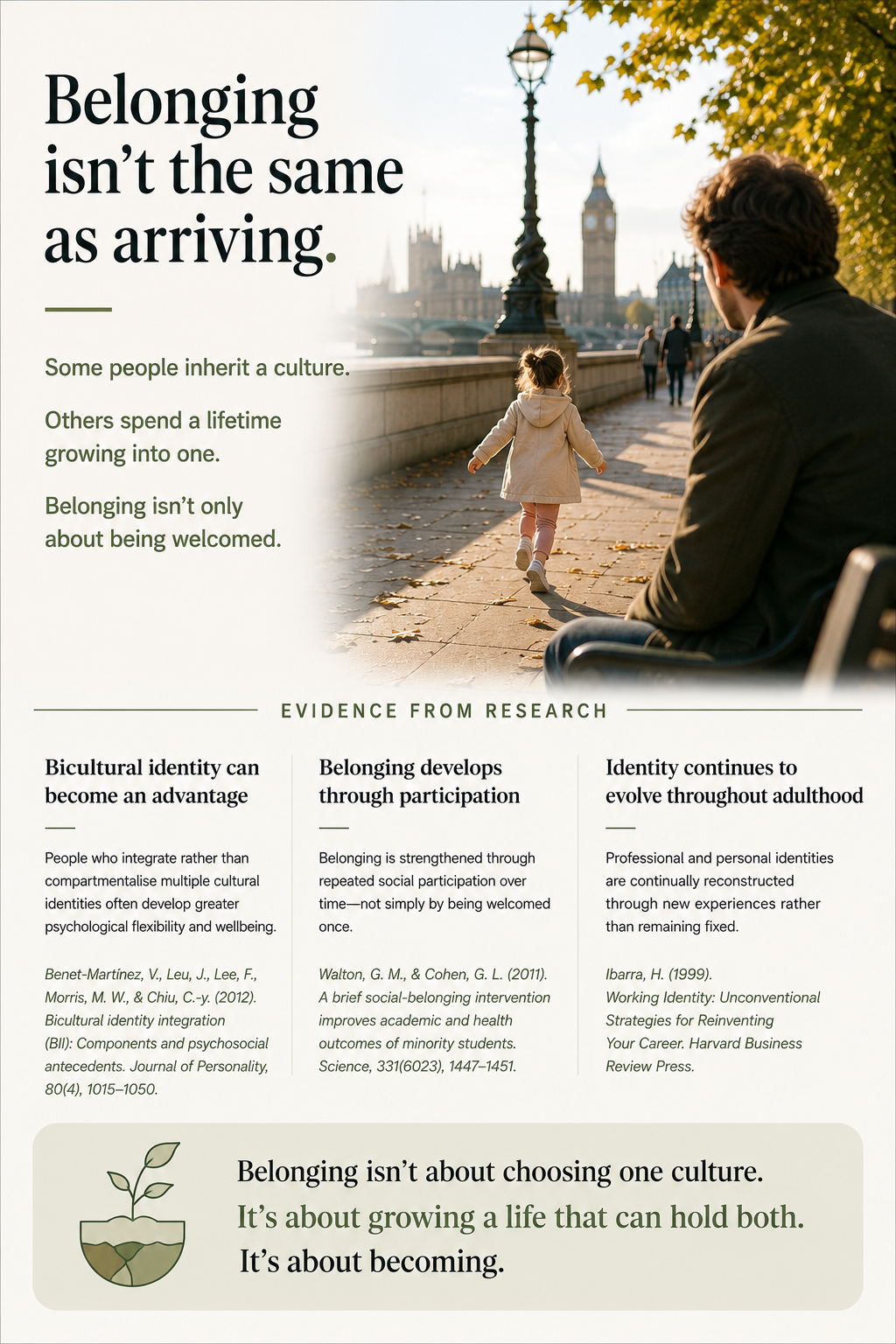
This is the third post in a continuing series on identity, leadership and what high-stakes environments teach us about both. The previous post, Can You Root in Two Countries?, looked at belonging somewhere you did not grow up.
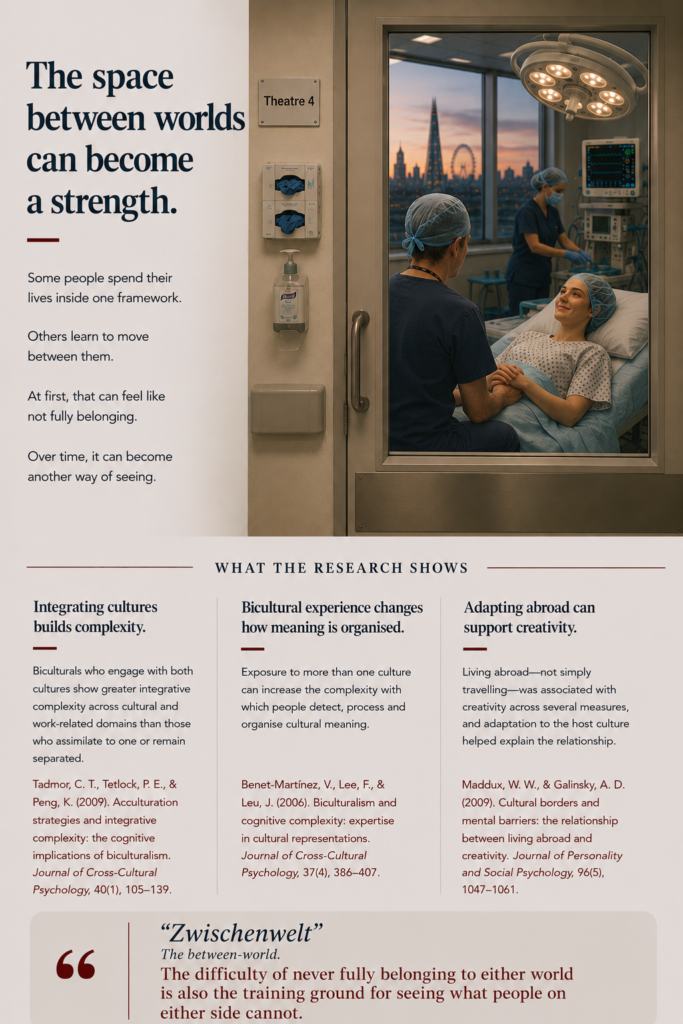
I recently asked a patient a very unusual question. She was frightened, but it felt like something quieter than the usual preoperative anxiety. I asked her whether she felt far from home. I wonder if I asked it because I knew what this particular kind of “alone” feels like.
She was Polish, six years in London, and she had nobody with her that day. My question came from eight years of being the person who is not quite from here. I believe this is not a deficit — it can be an advantage.
There is something bigger here. Many people carry more than one culture inside them, and most don’t realise it is an advantage rather than a complication. Not just people who moved countries. Anyone who has ever stood between two worlds that don’t quite translate into each other.
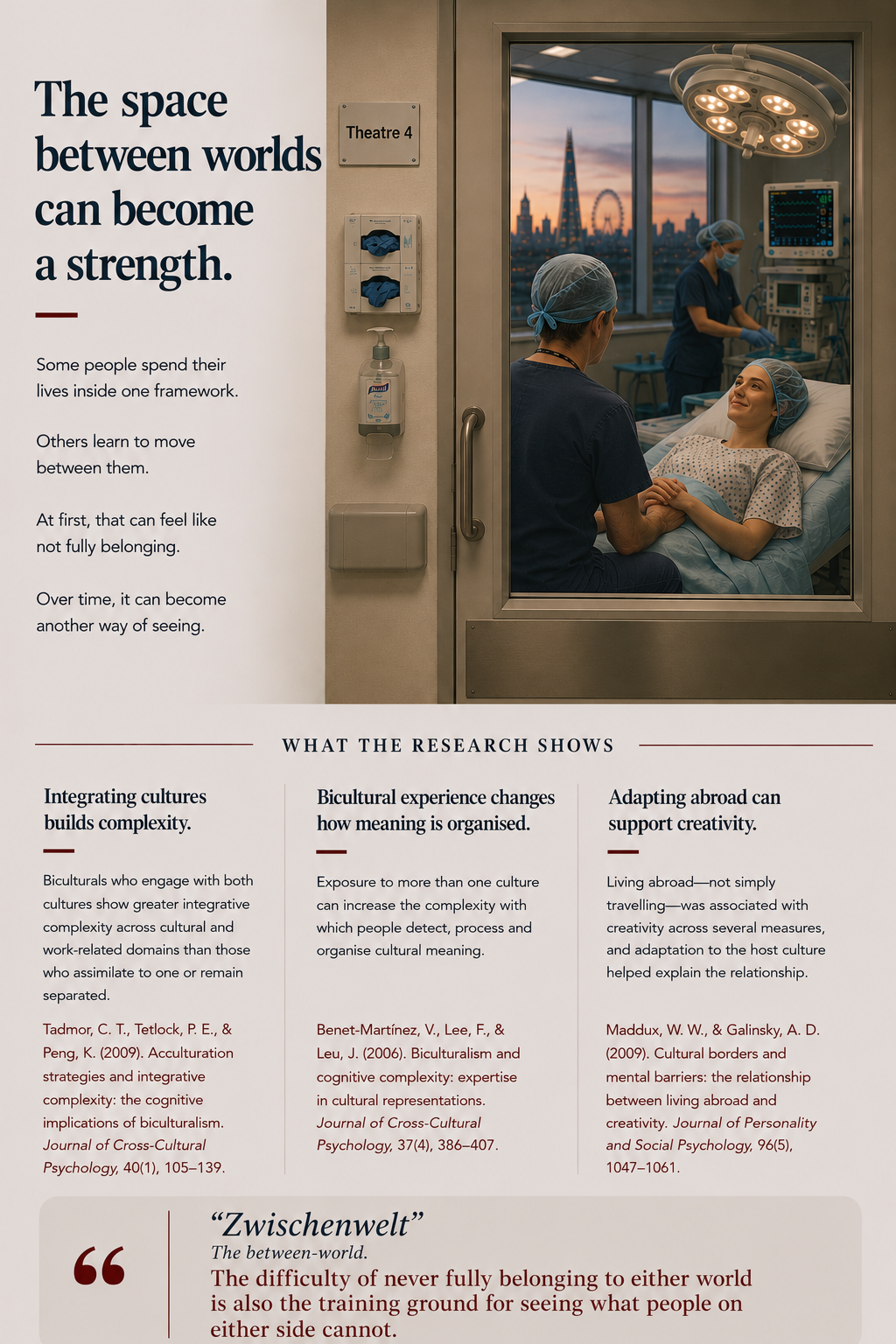
There is a German word for this space between two cultures: Zwischenwelt — a “between-world.” You don’t have to have moved countries to know the Zwischenwelt. It belongs to anyone navigating two worlds that don’t quite translate — a first-generation university student in an institution that wasn’t built for them, a northerner in a southern workplace, someone NHS-trained moving into private practice, or a resident doctor transitioning into consultant life.
This is where research helps explain what is happening. Tadmor and colleagues found that living in this Zwischenwelt space, without retreating to one side, gradually builds what they call integrative complexity — the ability to hold two competing frameworks at once without forcing a resolution. We do this every day. And Benet-Martínez and colleagues found something even more striking: people who experience their two cultures as compatible rather than in conflict show measurably greater creativity and problem-solving flexibility — not just in cultural situations, but in general thinking.
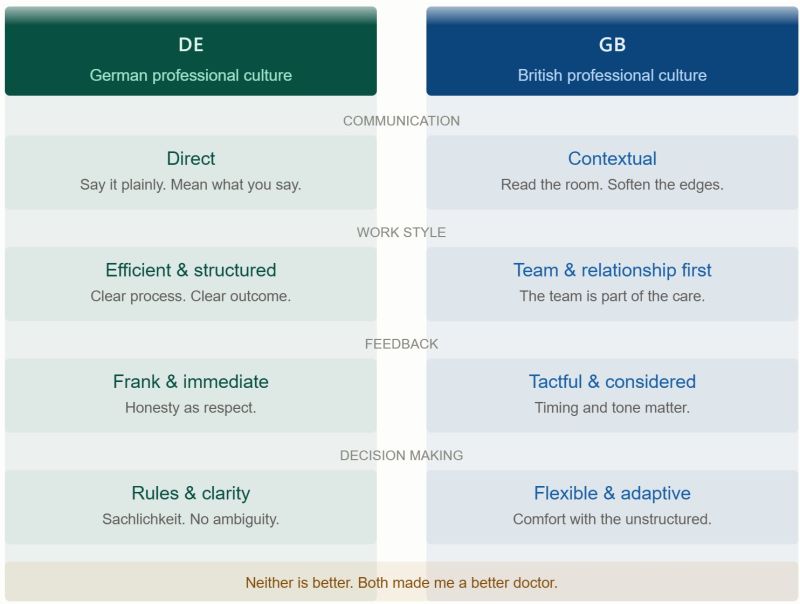
I see it in teaching too. When we built the online transfer medicine course with UCL, we worked with an international faculty and people from very different professional backgrounds — pilots, engineers, paramedics, nurses, and doctors. They all had their own framework and work culture, and they proposed different solutions, which made the course so interesting. Both solutions were right, within their own context.
So this is not a deficit to manage — I see it as an advantage. The difficulty of never fully belonging to either world is also the training ground for seeing what people on either side cannot. That is not something you learn in a classroom. The Zwischenwelt teaches it slowly, whether you asked for the lesson or not — and once you notice it, you can start using it on purpose.
What is the between-world you have had to navigate — and how could it be working for you rather than against you?
Next in the series: The Fastest Theatre List I Ever Worked, on what the outsider sees that insiders cannot.